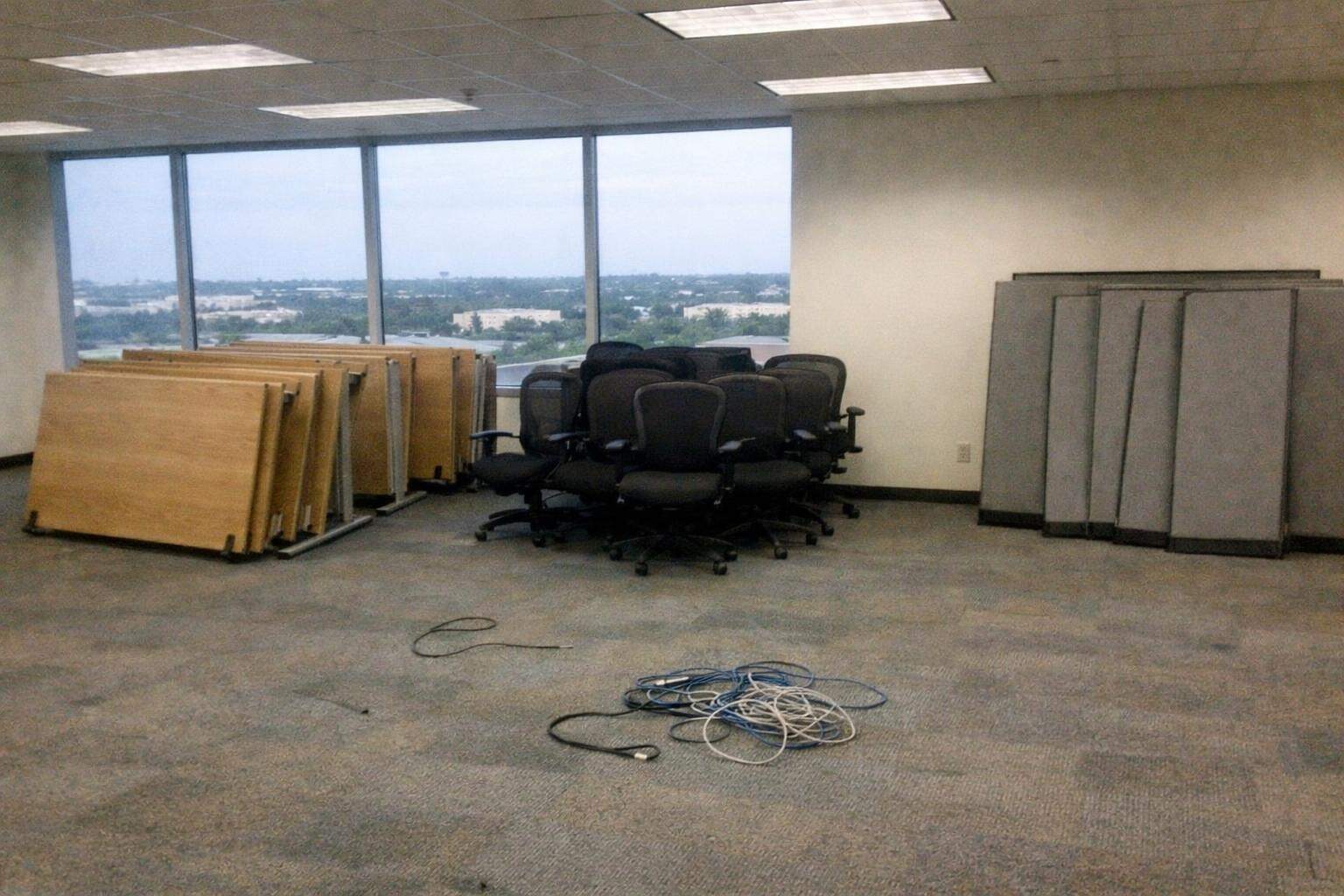
Commercial Junk Removal in Orlando, FL
Office suites, retail backrooms, restaurant kitchens, warehouse bays and apartment turns cleared across Orlando and Orange County. One written price from photos and a floor plan, a certificate of insurance for the property, and a crew that works around your hours.
- Quoted from photos and plans
- Certificate of insurance available
- After-hours loading by arrangement
What commercial junk removal includes
A commercial pickup arranged through this line clears a business space of the furniture, fixtures, equipment and leftover stock a tenant or owner no longer wants, with the price agreed in writing before loading and the labor, truck and disposal all included. The crew that takes the job carries from the suite, the stockroom or the bay to the truck, breaks down what has to be broken down, and leaves the floor broom-swept so the landlord's walkthrough is a formality. Multi-day and multi-load jobs are priced as a whole before day one.
Haulers routed from here handle the following from Orlando business properties:
- Desks, workstations, cubicle panels, conference tables, rolling chairs and filing cabinets
- Retail shelving, gondolas, display cases, mannequins, counters and signage
- Restaurant booths, tables, chairs, bar stools, prep tables and shelving racks
- Reach-in coolers, freezers, ice machines and other refrigerant equipment, routed for refrigerant recovery
- Warehouse racking that has been taken down, pallets, crates, packaging and dead stock
- Monitors, printers, copiers and other electronics, handled as e-waste
- Carpet tiles, ceiling tiles, doors and drywall from a tenant improvement that is already demolished
- Whatever a departed tenant left in an apartment, storage unit or office
The can't-take list holds on commercial jobs too, and the crew will repeat it when the quote is written:
- Paint, solvents, chemicals, fryer oil in drums and cleaning concentrates
- Fuel, propane cylinders and compressed gas
- Fluorescent tubes and ballasts
- Medical waste, sharps and anything regulated
- Ammunition, fireworks and flares
The county's free household hazardous waste drop-off is for residents, so a business with a closet of fluorescent tubes or a pallet of chemicals needs a commercial recycler for that part. Everything else on the list above goes on the truck. For a building's post-storm debris, covered under different county rules, see yard waste and storm debris removal.

Who books commercial junk removal in Orlando
The calls on this line come from five kinds of commercial client, and the job looks different for each. Office tenants downtown and along the I-4 corridor are the most common: a lease ending, a downsizing, a move to a smaller suite, and a floor of furniture the next tenant does not want. Retail operators closing or refitting a store need fixtures and shelving gone between the last trading day and the landlord's handover. Restaurants swap out kitchens and dining rooms, and the refrigerant equipment in a kitchen is the part a general hauler has to route correctly.
Warehouses and light industrial tenants in the Orlando Central Park and east Orange County areas call about racking that has already been dropped, pallets, packaging and stock that will never sell. Property managers are the fifth group and the steadiest. With 60.5 percent of the City of Orlando's occupied housing rented (2023 ACS), apartment turns, abandoned units and storage room clearouts are a weekly fact for the managers of the metro's larger communities, and the same managers call again after a hurricane because condominiums and manufactured home communities are treated as commercial under Orange County's debris rules and must arrange their own cleanup.
Hospitality sits across all of those. Orlando drew more than 75.3 million visitors in 2024 (Visit Orlando), and the hotels, vacation rental operators and attraction-area restaurants that serve them refresh rooms and dining spaces on short cycles. Vacation rental managers around Kissimmee and Four Corners in particular turn over whole houses of furniture at once, and a hauler who can clear a four-bedroom rental in a morning keeps the calendar open for the next booking. Where a departed residential tenant is the problem rather than a business, the eviction and foreclosure cleanout page covers that work.
How a commercial job is priced
Commercial pickups are priced by truck volume, the same way a residential job is, with the whole job quoted in writing before the first item moves. The haulers routed from here price by the fraction of the bed a load fills: a minimum load, a quarter, a half, three-quarters or a full truck, with individual items such as a copier or a reach-in cooler priced on their own. Half a truck is half the bed, and the crew shows the bed before and after each load so the fraction is something you can check rather than take on faith. On an office floor that will run several loads, the quote states the expected number of loads and the per-load rate up front.
What moves a commercial number, all named at quote time:
- Floor and elevator. A third-floor suite with a freight elevator reservation is quicker than a walk-up; a suite with no freight elevator and a long hallway to the dock takes longer.
- Loading rules. Buildings that only allow loading after 6pm or on weekends add crew time outside normal hours.
- Heavy material. Safes, stone countertops, cast-iron equipment and pallets of tile or product weigh more than furniture.
- Refrigerant equipment. Coolers, freezers and ice machines carry a recovery step before they can be scrapped.
- Breakdown. Cubicle systems and racking that have to be unbolted on site are quoted as labor on top of volume.
- Distance. A warehouse out past the airport or in Apopka is farther from the landfill than a downtown suite.
For scale, these are the national ranges, each a typical band confirmed by the written estimate rather than a promise:
| Load | Typical national range | Source |
|---|---|---|
| Minimum load, around 60 cubic feet | $75 to $125 | Fixr, updated January 2025 |
| Typical job | $150 to $600, with about $300 the national average | Fixr, updated January 2025 |
| Full truckload | $450 to $650 | Fixr, updated January 2025 |
| Per load, average | $150 to $350 | HomeGuide, May 2024 |
| 20-yard dumpster for a week | $280 to $699, $450 average | HomeGuide, May 2024 |
An office floor or a closed restaurant is usually several truckloads, so the written quote on a commercial job is a total for the scope you showed, broken into loads, with a rate stated for anything added on the day. No deposit is taken. The invoice is paid when the space is swept, and a net-terms invoice can be arranged for property managers who need one.
What happens to office furniture when a company downsizes
A news segment on where desks, chairs and workstations go when a company gives up a floor, and how much of it finds a second user instead of a landfill.

Video: KPIX CBS News Bay Area on YouTube
Can you quote an office from photos?
Yes, and photos plus a rough floor plan are the fastest way to a firm commercial number. The hauler we route needs a wide shot of each room or bay, a close shot of anything heavy or bolted down, a count of the big items (workstations, filing cabinets, coolers), the floor number, and the building's rules on docks, elevators and loading hours. With those, a written price per load and an expected load count come back before the crew is scheduled. For a larger floor or a warehouse, a site walk is available and still free, and a manager who wants a hauler to see the freight elevator before quoting should say so.
What makes a photo quote hold is showing everything. If a storage cage behind the suite is part of the job, photograph it. If the carpet is coming up too, say so. The complaint in this industry is a number that changes at the door, and the way to avoid it is a complete picture at quote time and a hauler who writes down what the price covers. If something turns up on the day that was never in the photos, it is priced before it is loaded rather than after.
Is it cheaper to rent a dumpster or hire junk removal for a business?
A dumpster is cheaper when the business has a place to put it, several days to fill it and staff who can do the lifting, and junk removal is cheaper once you count the staff hours and the days the container sits. HomeGuide puts a 20-yard dumpster at $280 to $699 for a week with a $450 average (May 2024), and Fixr puts a 10-yard at $200 to $550 with a $380 average (January 2025). Against that, a full truckload hauled and loaded by someone else runs $450 to $650 nationally per Fixr. The dumpster wins on paper when the volume is large and the labor is free. It loses when the landlord will not allow a container in the lot, when there is no lot, when the suite is upstairs, or when the space has to be handed back by a date and nobody on payroll is being paid to carry desks.
Downtown Orlando suites rarely have anywhere to put a container, and a retail center's landlord usually controls the lot. A hauler also handles the sorting a dumpster does not: the metal goes to a recycler, the usable furniture to a donation partner or a resale route, the coolers to refrigerant recovery, and only the remainder to the landfill. A dumpster takes everything in one hole at the Class I rate. For a tenant improvement that is still being demolished, the construction debris page covers when a container makes sense.
Why Orlando's free pickup programs do not apply to a business
The free large item programs in Orlando are residential, so a business has two routes: haul it to the county yourself or hire someone. City of Orlando residents get two hand-loadable large items picked up free on their yard waste day, and unincorporated Orange County households get three cubic yards a week, and neither applies to an office suite, a store or a restaurant. The Orange County landfill at 5901 Young Pine Road and the Porter and McLeod Road transfer stations will take a commercial load. Class I garbage is $56.40 per ton at every site under the rates effective October 1, 2026, construction and demolition material is $42.70 per ton at the landfill only, the minimum charge is $10, and an uncovered load is charged double.
Self-hauling works for a small business with a truck and a slow afternoon. It stops working when the load is an office floor, when the furniture has to come down a freight elevator on a schedule, or when the county's rules on refrigerant and white goods come into play. Fla. Stat. 403.708(12) bars landfilling white goods, so a reach-in cooler cannot go in the Class I pile; it goes to a metal recycler after the refrigerant is recovered, and a hauler with that route is the simpler call. A paid pickup is also the better choice when the handover date is fixed, when the crew has to work after hours, and when the manager needs a certificate of insurance on file before anyone touches the building.
Where office furniture, fixtures and equipment end up
A commercial load from Orlando is split four ways by a decent hauler: usable furniture to donation or resale, metal to a scrap recycler, electronics to an e-waste route, and the remainder to the Orange County landfill. The EPA's 2018 figures, the latest national dataset, put furniture and furnishings at 12.1 million tons of municipal solid waste with 80.1 percent of it landfilled, and office furniture is a large share of that because it is heavy, bulky and goes out all at once when a company shrinks. Desks and chairs in good condition are the easiest category to keep out of the landfill, and a donation receipt is available on request where a donation happens.
Two rules shape the equipment side. Under Fla. Stat. 403.708(12), white goods cannot be landfilled in Florida, which puts every cooler, freezer and ice machine on a metal recycling route. Under EPA Section 608, the refrigerant in that equipment has to be recovered by a certified technician before it is scrapped, and the final party in the disposal chain is responsible for keeping a signed recovery statement. A hauler that takes a walk-in's condenser or a row of reach-ins should be able to say who recovers the refrigerant. Monitors, printers and copiers are electronics, which the county keeps out of regular garbage; a business routes them to an e-waste recycler, and the hauler we route includes that in the quote.
Illegal dumping is a commercial felony. Under the Florida Litter Law, Fla. Stat. 403.413, dumping any amount for commercial purposes, or more than 500 pounds, is a third-degree felony with a fine up to $5,000 under s. 775.083. A cut-rate trailer that takes a floor of furniture for cash and tips it in a vacant lot can tie the business name on the paperwork to that lot. Ask where the load is going and keep the disposal receipt with the lease file.
What a property manager or business owner should check first
A commercial client has more paperwork at stake than a homeowner, so the checks on the hauler come first and are quick. Florida has no state license for junk hauling, so there is no license number to ask for; the haulers routed from here operate under an Orange County Business Tax Receipt and carry liability insurance, and a building that requires a certificate of insurance naming the property as additional insured should ask for it before the crew is scheduled rather than on the morning of the job.
- Certificate of insurance, with the building named where the lease requires it.
- The whole scope priced in writing, by load, before anything moves, with a stated rate for additions on the day.
- The can't-take list repeated at quote time, so the fluorescent tubes and the fryer oil are planned for.
- The disposal route by name: recycler, donation partner, landfill, with a receipt available.
- Who shows up. The crew that takes the job is the crew named at booking, in a marked truck.
- No deposit, and payment by card or invoice when the space is swept.
Managers who run several properties can keep one number on file. The line is answered seven days a week, pickups run 7am to 7pm Monday to Saturday with Sunday by arrangement, and same-day and next-day pickups are available when a truck is free. How the line is run is on the about page, and photos and plans can go through the contact page.
The services that usually sit beside this one
Most Orlando pickups mix two or three of these, and the pages below describe the ones that most often ride on the same truck.
- Eviction and Foreclosure Cleanout: Whatever a tenant left behind, cleared so the unit can turn over on schedule.
- Construction Debris Removal: Drywall, tile, lumber and torn-out fixtures hauled to the one county site that takes them.
- Yard Waste and Storm Debris Removal: Limbs, fronds, fence panels and screen frames, piled the way the county requires.
Commercial work runs on a schedule rather than once, and the about page covers how repeat pickups are arranged.
How a commercial cleanout gets arranged
A business pickup runs on a fixed scope and a fixed price, agreed before the crew is scheduled.
-
Send photos and the building rules
Call (407) 326-0014 or send wide shots of each space, a count of the big items, the floor, and the dock, elevator and loading-hour rules.
-
Get the scope priced in writing
The hauler we route replies with a per-load price, the expected number of loads, named add-ons, and the certificate of insurance if the building needs one.
-
Book the window the building allows
Evenings and weekends are arranged where a landlord restricts loading. Same-day and next-day pickups are available for a single suite when a truck is free.
-
Load, sort and sweep
The crew breaks down what has to be broken down, loads by destination, shows the bed before and after each load, and leaves the floor swept for the walkthrough.
-
Pay on completion
Card or invoice when the space is clear, with disposal and donation receipts available on request. No deposit.
Why Orlando businesses and property managers use this line
A commercial job has a handover date, a landlord and an insurance file attached to it, and the pickup is arranged with all three in mind.
The whole floor is priced before a desk moves
A commercial job is quoted as a total for the scope you showed, broken into loads at a stated per-load rate, with every add-on named and a rate written for anything found on the day. The crew shows the bed before and after each load. There is no deposit and the invoice is paid when the space is swept, which is how a manager keeps the number on the purchase order equal to the number on the invoice.
Fixr's January 2025 survey puts a full truckload at $450 to $650 nationally; a written per-load rate is what turns that range into one number.
Refrigerant equipment and electronics are routed the legal way
Reach-in coolers, freezers and ice machines cannot be landfilled in Florida and carry a refrigerant recovery step before scrapping, and monitors and copiers are kept out of regular garbage by the county. The haulers routed from here include those routes in the quote, so a restaurant or office closes out its lease without a disposal problem attached to the business name afterward.
Fla. Stat. 403.708(12) bars landfilling white goods; EPA Section 608 requires certified refrigerant recovery and a signed recovery statement.
Apartment turns and condo debris handled for managers who call weekly
With 60.5 percent of Orlando's occupied housing rented, property managers turn units every week and inherit whatever a tenant left. After a storm those same managers are told the county treats condominiums and manufactured home communities as commercial and will not collect. One number on file covers the Tuesday abandoned unit and the post-hurricane pile, each priced in writing before the truck is sent.
City of Orlando 2023 ACS: 60.5 percent of occupied units are renter-occupied; Orange County treats condos and manufactured home communities as commercial for storm debris (ocfl.net).
What Reddit Says About Commercial Junk Removal in Orlando
Commercial cleanouts are thin on Reddit compared with residential pickups, and what is there points the same direction as everything else in this industry. The office story that got recommended was a company quoted from photos and rough measurements, charged exactly the quoted number, and handed a donation receipt for the furniture that went on. The cautionary one was a property manager with three left-behind apartments that took two franchise truckloads for about $3,000, which commenters read as the cost of calling the biggest name on short notice. Those are figures posters reported in their own cities and years; the written estimate is what applies here.
Operators who post in those threads say their steady commercial work comes from property managers, storage facilities and apartment turns, and that insurance paperwork is required before most of it. That lines up with the vetting advice people give: ask for the certificate of insurance before the job, ask who is showing up, and treat a call center that confirms twice and then cancels, or a crew that turns out to be strangers in a pickup, as the red flag it is.
Photos first, a firm number, and that number on the invoice is the standard a business should hold any hauler to, and it is how pickups are arranged on this line.
A typical commercial cleanout call from a downtown Orlando office suite
The situation: A professional services firm on a mid-rise floor off Orange Avenue is giving up half its suite at lease end. Twenty workstations, a conference table, a wall of lateral files, a break room refrigerator and a closet of old monitors have to be out before the landlord's walkthrough, and the building only allows freight elevator loading after 6pm.
What gets done: The office manager sends photos of each area and a count of the workstations, plus the building's loading rules and a request for a certificate of insurance naming the property. The hauler we route prices the job in writing as a stated number of loads at a per-load rate, with the cubicle breakdown as labor and the refrigerator and monitors on their own lines, and the certificate goes to the building before the date. A crew works two evenings through the freight elevator, loads furniture in good condition separately for a donation route, bags the monitors for e-waste, and sweeps the floor.
How it turns out: The walkthrough passes, the firm pays the invoiced total it approved before the first evening, and the donation receipt and disposal receipt go in the lease file. The building's property manager keeps the number for the next tenant who leaves a suite full.
Commercial junk removal questions from Orlando businesses
The questions office managers, store owners and property managers ask before booking a commercial pickup, answered plainly.
Call (407) 326-0014Can you quote an office from photos?
Yes. Send a wide photo of each room, a close shot of anything heavy or bolted down, a count of the large items, the floor number and the building's dock, elevator and loading-hour rules. The hauler we route sends a written price per load and an expected load count before anything is scheduled. A free site walk is available for a large floor or a warehouse where a photo cannot show the access. Everything in the photos is covered by the number; anything found on the day is priced before it is loaded.
Can the crew work after hours or on a weekend?
Yes, by arrangement. Many downtown and I-4 corridor buildings restrict freight elevator and dock use to evenings or weekends, and the quote is written for the window the building allows. Standard pickups run 7am to 7pm Monday to Saturday, Sunday is by arrangement, and after-hours work is named in the written price rather than added later. Tell the dispatcher the building's rules on the first call so the schedule and the number are set together.
Will the hauler provide a certificate of insurance for the building?
Ask for it when the quote is requested and it can be arranged before the job. Florida has no state license for junk hauling, so the documents that matter are the Orange County Business Tax Receipt and the liability insurance the haulers routed from here carry. Where a lease or a property manager requires the building named as additional insured, say so up front so the certificate is on file before the crew arrives rather than being chased on the morning of the job.
Do you take commercial refrigerators, freezers and ice machines?
Yes, and they are priced on their own line because of the refrigerant step. Florida bars landfilling white goods under Fla. Stat. 403.708(12), and EPA Section 608 requires the refrigerant to be recovered by a certified technician before the unit is scrapped, so the hauler we route takes the unit to a metal recycler on that route rather than the landfill. Walk-in boxes that are still assembled need to be taken apart first, and a hauler should see photos before quoting that.
Is it cheaper to rent a dumpster or hire junk removal for a store closing?
A dumpster is cheaper when the landlord allows one in the lot, the store has days to fill it, and staff are doing the lifting; HomeGuide puts a 20-yard at $280 to $699 a week nationally (May 2024). Junk removal is cheaper once the loading labor, the container days and the sorting are counted, and it is the only option when there is nowhere to put a container or the handover date is tight. Most retail closings in Orlando's strip centers come down to the landlord's rule on containers and the date on the lease.
Can a property manager get an invoice instead of paying on the day?
Yes. No deposit is taken on any job, and a manager who needs net terms, a purchase order number on the invoice or a disposal receipt attached for the owner can arrange that when the quote is written. Payment is by card or invoice, and tips are never expected. Managers with several communities can keep one number on file so an abandoned unit, a storage room clearout and a post-storm condo pile are all quoted the same way, in writing, before a truck is sent.