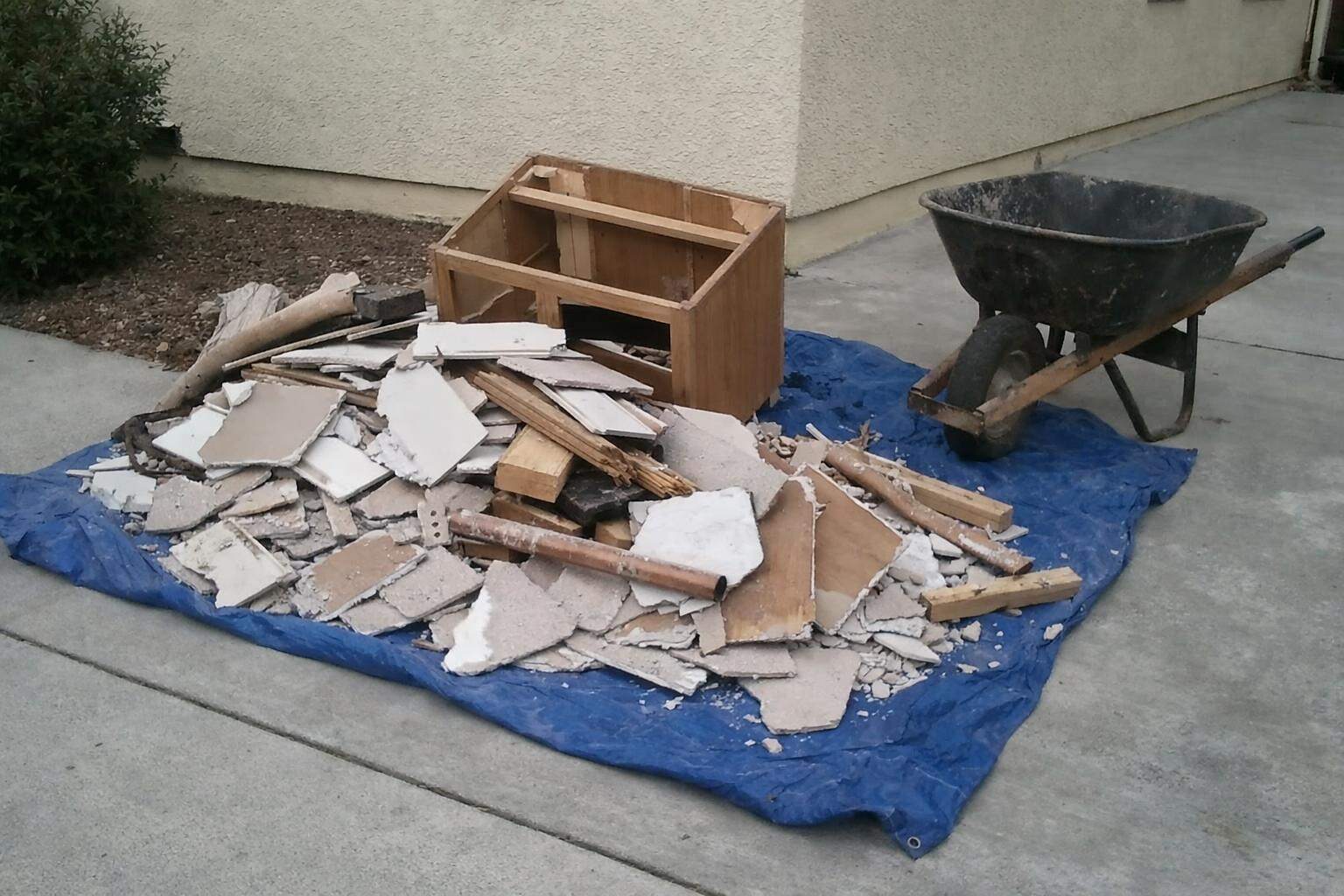
Construction Debris Removal in Orlando, FL
Renovation leftovers, demolition piles and contractor debris loaded and hauled across Orlando and Orange County by insured local haulers, with the price agreed in writing before the first bucket of tile goes on the truck.
- Price agreed before loading
- Heavy material priced plainly
- Same and next day available
What construction debris removal in Orlando includes
Construction debris removal covers loading, hauling and disposal of the material a renovation, a demolition or a contractor leaves behind, from wherever it sits on the property. The crew that takes the job brings the labor, the truck or dump trailer, the wheelbarrows and the dump fees, then sweeps the area once the pile is gone. Loose piles in a backyard, bagged drywall in a garage, a stack of old cabinets in the kitchen and a torn-out deck all count.
Hauled on a construction debris job:
- Drywall, plaster, lath and insulation offcuts
- Lumber, trim, doors, cabinets, countertops and vanities
- Tile, grout bags, backer board and broken ceramics
- Concrete, pavers, brick, block and dirt (priced by weight)
- Roofing shingles, felt, flashing and gutters
- Fencing, deck boards, pergolas and screen enclosure frames
- Carpet, padding, laminate and vinyl flooring
- Windows, sliding doors, sinks, toilets and tubs
- Metal studs, conduit, ductwork and old water heaters
Left for another route:
- Asbestos-containing material such as old floor tile mastic or popcorn ceiling, which the county landfill takes only by appointment through a licensed abatement contractor
- Paint, solvents, adhesives, roofing tar and fuel (free county HHW drop-off, below)
- Fluorescent tubes and ballasts (HHW)
- Propane and refrigerant cylinders (HHW for the small cylinders; the county refuses gasoline cylinders)
- Treated lumber in bulk may carry a surcharge at disposal; say so at the estimate
Debris from a hurricane repair is a special case. Orange County collects storm debris only from residents, and contractor-generated debris is never collected under the free program, so the roofer's old shingles or the fence company's broken panels need a hauler regardless of the storm. The yard waste and storm debris page covers the vegetative side.

How construction debris removal is priced
Construction debris is priced by how much of the truck it fills, with a weight adjustment for dense material, and the number is written down before loading. Haulers work in fractions of the bed: minimum load, quarter, half, three quarters, full. Half a truck means the bed is half full to the fill line, and a decent crew points to the line before and after loading so you can see the fraction yourself. The part that surprises people on renovation jobs is weight. A half truck of drywall and trim weighs a fraction of a half truck of tile or concrete, and the landfill charges by the ton, so very heavy material carries its own adjustment or its own per-load price.
Other adjustments the estimate will name: stairs or a second-floor carry, a long carry from a backyard with no gate access, debris that has to be bagged or broken down before it can be loaded, and material that needs a separate disposal route. The Orange County landfill charges $42.70 per ton for construction and demolition debris under the rates effective October 1, 2026, with a $10 minimum, and uncovered loads are charged double, which is why a covered truck or trailer matters to the hauler's cost.
| Load or option | Typical national range | Source |
|---|---|---|
| Minimum load (about 60 cubic feet) | $75 to $125 | Fixr, January 2025 |
| Typical junk removal job | $150 to $600 | Fixr, January 2025 |
| Full truckload | $450 to $650 | Fixr, January 2025 |
| 10-yard dumpster, one week | $220 to $580, $350 average | HomeGuide, May 2024 |
| 20-yard dumpster, one week | $280 to $699, $450 average | HomeGuide, May 2024 |
Those are national typical ranges and dense material sits at the top of them or above. The figure that counts is the one on the written estimate, agreed before anything is loaded, with no deposit and payment when the job is done.
Hauler or dumpster: compare the two for your pile
Four questions, scored against the published national ranges further down the page. The range stays wide on purpose: nobody can judge a truck fraction from a form, and the written estimate is what fixes the number.
Ranges come from Fixr (updated January 2025) and HomeGuide (May 2024) national cost data. The hauler confirms the figure in writing before loading.
Is it cheaper to rent a dumpster or hire junk removal for remodel debris?
A dumpster is cheaper when the job runs more than a few days, the driveway has room for a container, and someone on site is willing to load it. Junk removal costs about the same or a little more and wins when the pile is ready now, when nobody wants to spend an afternoon loading, when there is no room for a container, or when the HOA will not allow one at the curb. HomeGuide (May 2024) puts a 10-yard dumpster at $220 to $580 for a week, Fixr (January 2025) puts a full truckload of junk removal at $450 to $650, and a 10-yard container holds roughly what a full truck does, so the two options overlap once labor is counted.
Dumpster rental carries its own small print. Weight limits with overage fees per ton, a permit if the container sits in the street, neighbors filling it overnight, and a pickup fee that sometimes appears on the final bill. The City of Orlando offers a dumpster bag pickup at $100 per bag for residents, which suits a bathroom's worth of debris and little more. A hauler's number includes the labor, the drive and the dump fee in one line, and the material is gone the day the crew arrives.
A fair rule from contractors: container for a gut renovation that runs weeks, hauler for a one-room remodel, a deck demo or the pile the contractor left when the job wrapped.
How mixed construction debris is sorted and recycled
The video follows a mixed debris load through a recovery facility where concrete, wood, metal and drywall are pulled apart and sent on separate routes.

Video: TOP Discovery 4K on YouTube
What you can do for free or cheaply in Orlando first
The free curbside programs in Orlando take almost no construction debris, so the realistic cheap route is a self-haul to the county landfill. City of Orlando residents get two hand-loadable large items collected free on yard waste day (a sink, a toilet, a cabinet qualifies), per orlando.gov, and the city notes that some construction material goes out free on yard waste day in small amounts. Unincorporated Orange County allows three cubic yards of large items a week, set out before 6am (ocfl.net). Neither program takes a demolition pile.
With a truck or trailer, a resident can take construction and demolition debris to the Orange County landfill at 5901 Young Pine Road, the only county site that accepts it, at $42.70 per ton with a $10 minimum under the October 1, 2026 rate sheet. The Porter and McLeod Road transfer stations refuse construction debris entirely. Cover the load, because an uncovered load pays double. Paint, solvents, adhesives and fluorescent tubes left from the job go free to the HHW drop-off at the landfill or Porter, Monday to Saturday 8am to 5pm, with paint limited to 25 gallons per vehicle.
A paid hauler is the better call when the pile outweighs what a pickup can carry, when the material is concrete or tile that nobody wants to lift twice, when the debris is inside the house, when the job has a deadline such as a final inspection or a tenant moving in, and when the driveway needs to be clear by the weekend. The general junk removal page covers mixed loads where household items and renovation leftovers go together.
Do you take drywall and old cabinets?
Yes, drywall and old cabinets are among the most common loads on a renovation pickup, and both are light enough to be priced by truck fraction rather than weight. Drywall goes in bagged or in sheets; the crew that takes the job prefers it stacked, because loose broken gypsum takes twice as long to load. Cabinets come out as boxes, doors and face frames, and intact ones in decent shape can go to a building materials reuse store rather than the landfill, with a donation receipt available on request where that applies.
Countertops are the exception to easy. A granite or quartz slab is heavy, awkward and sharp, and it gets priced as a single heavy item. Laminate tops go with the cabinets. Vanities, medicine cabinets, mirrors and the old toilet from the same bathroom all ride together, and the estimate will say whether the toilet and sink count as single items or as part of the fraction.
Why renovation debris piles up in Orlando
Orlando's housing stock is split almost in half by age, and the older half is where the renovation debris comes from. The City of Orlando counted 152,600 housing units in the 2023 ACS, with 47.7 percent built before 1990, which means tens of thousands of kitchens, bathrooms and roofs are into their second or third remodel. About 60 percent of the city's homes are renter-occupied, so landlords and property managers turning units between tenants generate a steady run of flooring, cabinet and bathroom debris.
Hurricane season adds the second wave. After Ian and Nicole, Orange County collected roughly 355,000 cubic yards of debris in 7,940 truckloads between October 2022 and January 2023, by its own newsroom count, and the county only picks up from residents with vegetative and construction debris in separate piles. Gated communities are excluded from county pickup, condos and manufactured home parks are treated as commercial, and contractor debris is never collected. A roofer's tear-off, a pool screen rebuild and a fence replacement all leave a pile that needs a hauler, and in a gated HOA the association often arranges it.
Vacation rental turnover around Kissimmee and the Four Corners area adds a third stream, since Osceola County holds more than 30,000 vacation homes (Experience Kissimmee, July 2026) and managers refresh flooring, tile and furniture on a short cycle. Osceola has its own landfill and rates; the hauler will use whichever site is closer and say which one.
Where construction debris goes after pickup
Most construction debris from an Orlando job goes to the Orange County landfill on Young Pine Road, where it is charged as Class III construction and demolition material, with metal pulled out for recycling and reusable fixtures diverted where there is a taker. The landfill rate is $42.70 per ton, effective October 1, 2026, and mixed loads are charged at the higher Class I rate of $56.40, which is one reason a hauler keeps construction debris and household garbage apart on the truck. Clean concrete and block can sometimes go to a private crushing yard for less than the landfill rate. Metal studs, ductwork, copper, water heaters and appliances go to a metal recycler, and in the case of white goods Florida Statute 403.708(12) requires that route, since appliances cannot be landfilled. Any refrigerant unit pulled during a remodel, such as a window air conditioner, must have the refrigerant recovered by a certified technician under EPA Section 608 before it is scrapped; the appliance removal page explains that chain.
Orange County as a whole landfilled 70 percent of the 4.2 million tons it collected in 2024, against a statutory recycling goal of 75 percent, and the county's own landfill has about 14 years of permitted airspace left on the Florida DEP's October 2024 estimate. Construction debris is the easiest category to divert, which is why the hauler we route asks what is in the pile before loading it.
The other reason to ask where a load goes is Florida's Litter Law, s. 403.413. Dumping more than 500 pounds, or any amount for commercial purposes, is a third-degree felony carrying a fine of up to $5,000, and a contractor's debris found in a vacant lot can be traced to the job by a receipt or an address on a box. A hauler who names the facility and offers the dump receipt has nothing to hide, and the written estimate says which site the load is headed for.
What to check on the hauler before a construction debris pickup
Ask for proof of insurance, a written price before loading, the weight rule for heavy material, and the name of the disposal site. Florida has no state license for junk hauling; the haulers routed from here operate under an Orange County Business Tax Receipt and carry liability insurance, and whoever attends should show it on request. On a debris job in particular, confirm:
- The written estimate names the truck fraction or per-load price, the heavy-material adjustment, any stairs or long-carry charge, and the items the crew will leave behind, repeated from the quote call.
- The crew shows the fill line before and after loading.
- The load is covered for the drive, since the landfill doubles the fee on uncovered loads and loose debris on the road is the hauler's liability.
- No deposit is taken, tips are never expected, and payment is made when the pile is gone and the area is swept.
Contractors sending a hauler to a client's home should also confirm the hauler can provide a certificate of insurance naming the property, which most insured haulers can produce. How jobs are routed is covered on the about page, and the contact page lists the hours.
The services that usually sit beside this one
Most Orlando pickups mix two or three of these, and the pages below describe the ones that most often ride on the same truck.
- Junk Removal: Mixed household loads priced by the fraction of the truck they fill, agreed before loading.
- Yard Waste and Storm Debris Removal: Limbs, fronds, fence panels and screen frames, piled the way the county requires.
- Appliance Removal: Refrigerators, washers, dryers and water heaters, with the refrigerant handled by the rules.
Renovation debris and the furniture a remodel displaces often share a truck, as the about page describes.
How a construction debris pickup gets arranged
Four steps from the photo to the swept driveway.
-
Send a photo of the pile
Call or send a wide shot with everything in frame. Say what the material is, whether any of it is concrete or tile, and where it sits on the property.
-
Get the written estimate
The hauler returns a price by truck fraction or per load, with the heavy-material adjustment named. Nothing is loaded until that number is agreed.
-
Load and haul
The crew loads from wherever the debris sits, shows the fill line, covers the load and heads to the Young Pine Road landfill or a recycler.
-
Sweep and settle up
The area is swept, payment is made when the job is done, and the dump receipt is available on request.
Why contractors and homeowners in Orlando route debris pickups through here
Renovation debris is where weight surprises happen, so the pricing is set up to prevent them.
Heavy material priced before loading
Tile, concrete, pavers and plaster weigh far more per cubic foot than drywall and trim, and the landfill charges by the ton. The estimate names the weight adjustment up front from the photo, so a half truck of broken tile is priced as a half truck of broken tile before the crew lifts a bucket. The number on the written estimate is the number paid.
Orange County landfill C&D rate $42.70 per ton, $10 minimum, uncovered loads charged double, effective October 1, 2026 (ocfl.net).
The only county site that takes it, and the hauler knows the way
Construction debris is refused at both Orange County transfer stations and at the curb under every free program, so it has exactly one county destination. The haulers routed from here run to Young Pine Road regularly, keep construction debris separate from household garbage to avoid the higher mixed-load rate, and can produce the dump receipt on request. Clean concrete and scrap metal are pulled out for a crusher or a recycler where that saves on the tonnage.
Orange County lists the Young Pine Road landfill as the only county site accepting Class III construction and demolition debris (ocfl.net).
Same-day and next-day pickups available
A pile in the driveway blocks the next trade and annoys the HOA. Same-day and next-day pickups are available across Orlando and Orange County, with pickups running 7am to 7pm Monday to Saturday and Sunday by arrangement. A single crew visit replaces a container that sits for a week and a second trip to retrieve it, and the written price covers the labor, the drive and the dump fee in one line.
Fixr (January 2025): a 10-yard dumpster rents for $200 to $550 a week, $380 average, before overage or permit fees.
What Reddit Says About Construction Debris Removal in Orlando
Reddit's default advice on remodel leftovers is a small dumpster or a trip to the transfer station, and the posters who hire a hauler anyway explain when that advice fails: no room for a container, one afternoon's worth of debris, or a pile that needs to be gone before the next trade arrives. People report a four-yard container under $200, mini dumpsters that fit in a garage from about $230 to $250, and a dumpster bag at roughly $219 plus a fee, each in their own city and year.
The cautionary stories are about national franchises. One poster was quoted about $1,000 for countertops and vanities, said no, and watched it drop to $500 once a $350 truck minimum was admitted. Another had a deck demolition quoted at $4,000 and done by a neighborhood contractor for $1,000, with a thread full of warnings about uninsured demo work. The pattern posters hate is a crew that quotes high on site, phones the boss when told no, and comes back with half the number.
The positive stories are the ones that read like a fair trade: sixty rotten deck boards gone the next day for $120, a backyard of debris cleared in ninety minutes at the quoted price, and two or three thousand pounds of concrete wheelbarrowed out of a yard with no gate access for less than the photo estimate. What those jobs had in common was a price from photos, held at the door.
Two surprises come up often enough to state here. Construction loads carry their own dump fee at the landfill, and haulers pass that through, so posters are caught off guard by a surcharge for construction materials even when nothing hazardous is involved. And intact cabinets and doors can go to a reuse store instead of the landfill, which posters wish they had been told before the crew loaded them.
The estimate here comes from photos with the weight adjustment named, and the number is written down before loading, which is the version of the job those threads describe wanting.
A typical construction debris call from a bathroom remodel in College Park
The situation: A homeowner in a 1950s College Park bungalow has finished a bathroom remodel with a contractor who left the tear-out behind: two pallets' worth of broken tile and mortar, a cast iron tub, a vanity, a toilet and a stack of soaked drywall, all piled under the carport. The HOA has already sent a note, the pile is too heavy for the household's sedan, and the owner is braced for a price that climbs once someone lifts the tile.
What gets done: A wide photo goes to the dispatcher. The hauler we route prices it as a half truck with a heavy-material adjustment for the tile and a single-item price for the cast iron tub, in writing, before the crew comes out. Two crew load the tile by bucket, carry the tub on a dolly, break down the vanity and bag the drywall, then show the owner the bed at the fill line. The load is covered for the drive to Young Pine Road, the tub and the metal fittings go to a recycler, and a half can of adhesive is left for the owner to drop at the county HHW site.
How it turns out: The carport is swept by midafternoon, the number matches the written estimate from the morning, and the dump receipt arrives on request. The HOA letter is answered with a photo of an empty carport.
Construction debris removal questions from Orlando
Answers to what homeowners and contractors ask before booking a debris pickup.
Call (407) 326-0014Cheap dumpster or junk hauling for remodel debris?
A dumpster is the cheaper tool when the remodel runs for weeks, the driveway has room, and someone is willing to load it a few bags at a time. Junk hauling costs about the same for a single pile and wins when the debris is ready now, when the material is heavy, when the HOA will not allow a container, or when nobody wants to spend the afternoon loading. HomeGuide (May 2024) puts a 10-yard dumpster at $220 to $580 for a week, and Fixr (January 2025) puts a full truckload of hauling at $450 to $650, so the gap narrows once labor and the pickup fee are counted.
Do you charge extra for construction materials?
Heavy construction material carries an adjustment, and the estimate names it before loading. Drywall, trim, cabinets and carpet are priced by truck fraction like any other load. Tile, concrete, pavers, plaster and dirt weigh several times more per cubic foot, and because the Orange County landfill charges $42.70 per ton for construction debris, a hauler prices dense material by weight or as its own load. Ask for the heavy-material rule in writing at the estimate, and send a photo that shows what the pile is made of so the number reflects it.
Can the crew take debris from inside the house?
Yes, the crew loads from wherever the debris sits, including upstairs bathrooms, interior rooms and backyards with no gate. Stairs, a second-floor carry or a long route around the house are adjustments the estimate names up front, since a bucket of tile carried down a flight takes longer than the same bucket lifted off a driveway. If the debris can be moved to the garage or driveway before the crew arrives, say so, because loading from a pile at the curb is the fastest and cheapest version of the job.
Will Orange County pick up my contractor's debris after a storm?
No, Orange County never collects contractor-generated debris, even after a declared hurricane. The county's storm pickup covers residents' own vegetative and construction debris in separate piles, with limbs under three feet and 60 pounds, and it cannot enter gated or private communities at all. A roofer's tear-off, a pool screen rebuild or a fence contractor's broken panels need a paid hauler regardless of the storm, and in a gated HOA the association usually arranges it. The hauler we route will take mixed storm and construction debris together, which the county program will not.
Do I need to be home for the pickup?
Only if the debris is inside the house or behind a locked gate. A pile in the driveway or at the side of the house can be loaded while you are at work, provided the written estimate has been agreed beforehand and the crew can reach the pile. Many people leave a gate unlocked and a photo of the pile marked so nothing else gets taken. Payment is made when the job is done, by card or invoice, and the swept area and the dump receipt are there when you get home.